or: Sometimes even Gentlemen need to sail to windward
Casting off#
At 7 am on 1 June 2026, we cast off and Karsten steers the Contessa 32 Lucy out of Finkenwerder harbour and into the Elbe fairway. Our destination is the Solent – the traditional mecca of the sailing world. Two days earlier, as arranged, Karsten had collected me from Hamburg Central Station. We had previously spoken by video conference and both had the same feeling: this could work for the two of us aboard Lucy on the 600-nautical-mile passage from the Elbe, across the North Sea and through the Channel to Lymington in Britain. We have the ebb with us, but the wind deserts us. Under engine, we reach Glückstadt in the early afternoon. There is ample time for a stroll around the pretty little town. Before long we are sitting in the sunshine outside a bakery, whiling away the afternoon over cappuccino and cake and gradually getting to know one another better. Yes – this will work!
On to Cuxhaven#
The wind is no more use to us on the passage to Cuxhaven the following day. Finding a berth is a challenge, for a powerful tidal stream runs through the harbour and makes every manoeuvre demanding. Eventually, though, we are securely tied up. Unfortunately, we are stuck in another sense too: the wind forecast for the next day is dreadful – a strong westerly, almost dead on the nose. It would mean motoring all the way, and the expected sea would reduce us to a snail’s pace. Given the conditions, stopping at Helgoland is no solution either. We opt for sightseeing in CUX, only to discover that the attractions on offer are very, very limited. Dinner is fish in the historic fishing harbour. Then, on our way back, comes the highlight of the day. Shortly before closing time, we happen upon the “Bahlsen Outlet Cuxhaven”: biscuits, chocolates and other sweet things of every description, in ordinary, large and very large packets. Being health-conscious sorts, naturally, we restrain ourselves and buy only a modest quantity. In retrospect, this is rather foolish, because our need for easily consumed calories is about to rise dramatically. That evening brings a surprise. According to Deutscher Wetterdienst, Windy and the usual suspects, a weather window appears to be opening – only a crack, admittedly, but a window nonetheless. From about 10 pm the night after next, the wind is forecast to veer southerly for a few hours. That might be enough to cross the Weser and Jade estuaries and make the passage north of the East Frisian Islands under sail. Above all, it offers hope that we shall not have to fight a contrary sea on this stretch. Even so, it is a difficult decision, as the DWD is warning of gusts of 6–7 Bft. Each of us quietly weighs it up, and each reaches the same conclusion: we can do this. We want to do this. So we have one more peaceful night in harbour, buy a few provisions the following morning, then prepare for the night passage.
Against the wind#
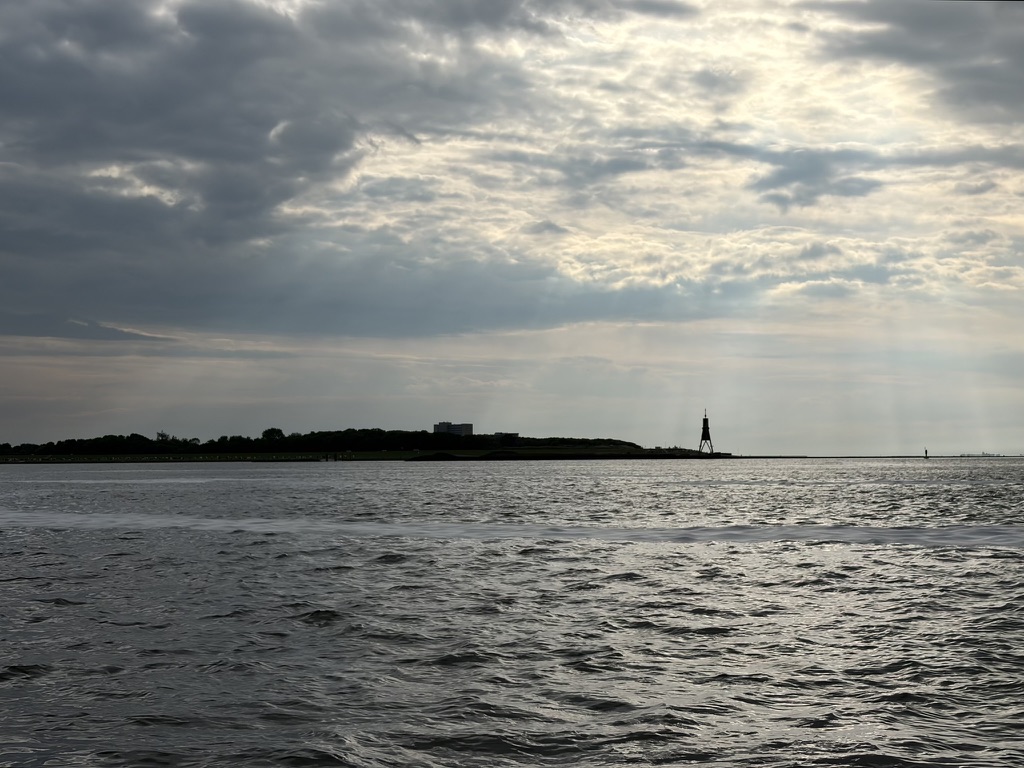
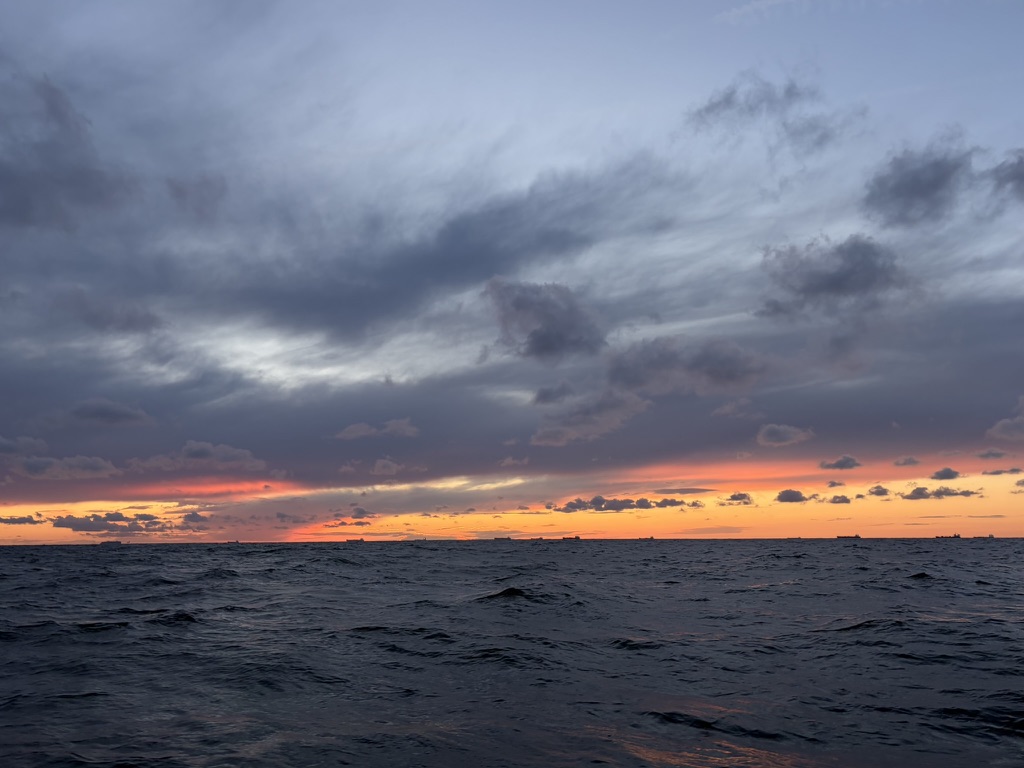
At 6 pm we cast off and motor down the Elbe with the tide. Off Gelbsand we cross the Elbe fairway, work our way north-west along the edge of the Neuwerk mudflats and are delighted when, beyond the Scharhörn Reef, we can alter course to WSW. The North Sea proper greets us first with violent rain squalls – rainwater and seawater merge into one, and at times in the gathering dusk visibility vanishes altogether. The AIS, meanwhile, shows shipping traffic increasing sharply. There had been astonishingly little commercial traffic on the Elbe, but now we seem to have sailed into rush hour – big ships coming from and going in every direction, entering and leaving the Jade and Weser estuaries and heading to and from the traffic separation schemes. A pilot boat, lit up like a Christmas tree, circles us at a respectful distance, as though wishing to make sure that the crew of this small yacht, out at night among all the professionals, knows what it is doing. At last the wind veers as forecast, the engine earns a well-deserved rest, and we can switch off the steaming light, which makes it easier for the powered traffic around us to read our intentions. Thanks to AIS, which I learn to love that night, the commercial shipping in our vicinity becomes much easier to sort out. This is particularly true as we pass the large anchorages south-east of the traffic separation schemes. The lights of the many ships at anchor form a sea of illumination, from which AIS makes it far easier to pick out those under way. There is also the reassuring knowledge that the big ships have our signal on their screens, at least. The wind freshens in earnest, and on our close-hauled course the pressure on the helm becomes unhealthy – time to reef. Karsten draws the short straw: clipped to the jackstay, he makes his way forward and, standing waist-deep in spray, reefs the mainsail at the mast. The effect is immediate. With considerably less heel, we are a knot faster. Lucy sails with splendid steadiness and lays her ear neatly in the water in the gusts, something I had not expected at all from a boat barely 3m wide; I merely have to grow accustomed to the water reaching the top of the cockpit coaming in some of the squalls. Even so, life aboard becomes fairly arduous, with the wind instrument repeatedly sitting above 30 knots for minutes at a time. Every second wave at least throws the boat into an abrupt and unpredictable movement, yet even now nothing below creaks or bangs as I am used to on charter yachts. Food is largely abandoned; through the night I subsist chiefly on glucose tablets. The unavoidable trip to the heads, wrestling out of and back into oilskins and the rest in the dancing forecabin, becomes a risky feat of strength. The sea is not especially high, but it is steep, and its rapid succession forces us to wedge ourselves firmly beneath the shelter of the sprayhood. We keep one hand on the tiller throughout the night. With regular dousings of seawater sluicing over the clear panel, it is almost impossible to make out anything precisely through it. Steering a reasonably true course demands a great deal of concentration and strength. Our eyes are mostly fixed on the steering compass, flicking at short intervals to the AIS screen. It is something of a relief when, after passing Wangerooge, we leave the dense shipping behind. Between the East Frisian Islands and the VTG to the north, apart from a few fishing boats, there is an almost yawning emptiness. Karsten and I settle into a 90-minute watch rhythm. We both need those short spells of sleep to recharge our batteries by turns. By now we trust one another completely not to do anything foolish when alone in the night-time cockpit, even in these difficult conditions, so we quickly drop off during our brief periods below.
Borkum at last#
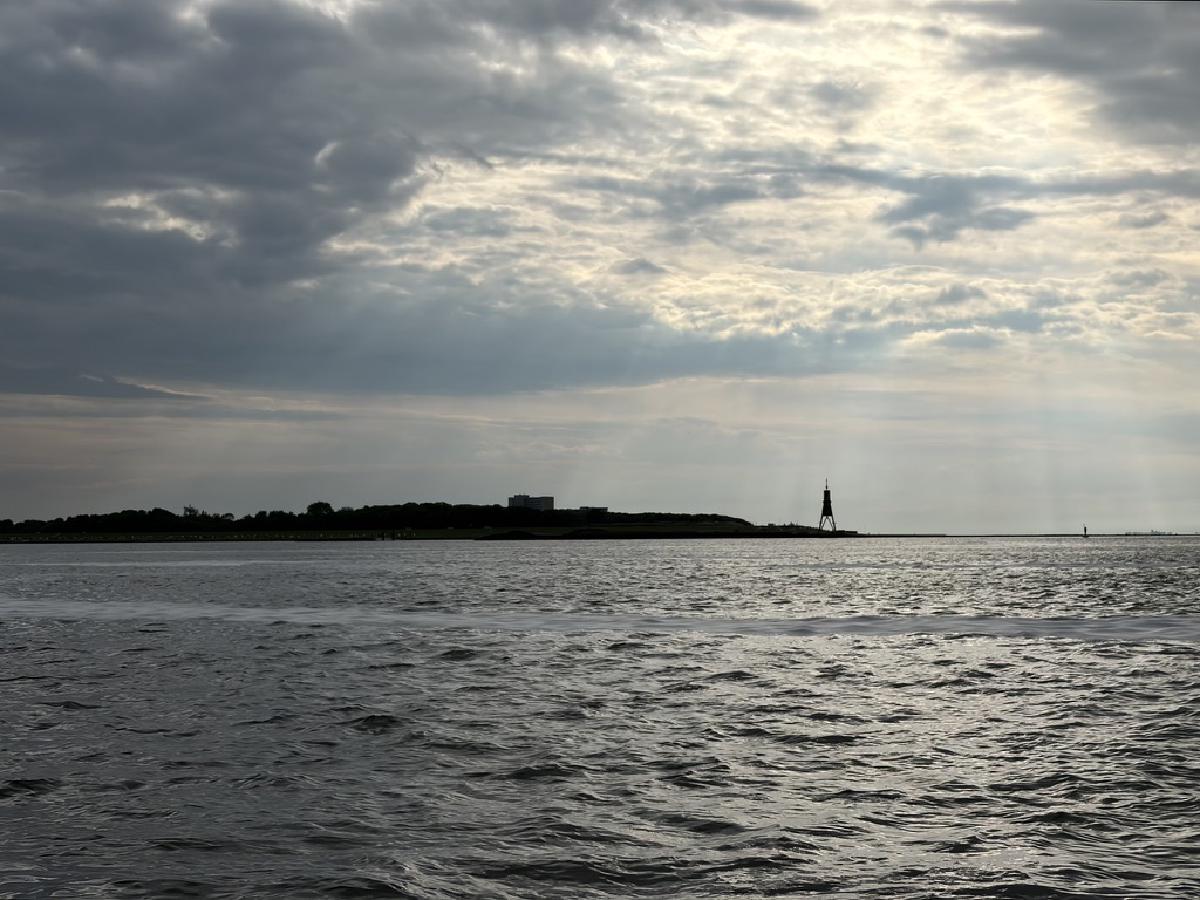
In June the nights are short and dawn comes early. We are making good progress and can already picture ourselves breakfasting in Borkum harbour. But we have reckoned without the North Sea. The wind veers back towards the west and, as the tide turns, a thoroughly confused sea builds. It is not dramatic, but it is extremely obstructive. The sails slat uncontrollably with the boat’s motion and no longer steady her even when we tack Danish-style, so we have to take them down. Sea and tidal stream hold us back; even under engine we limp towards our destination at just 2.5 knots over the ground. Laboriously, we tick off one after another of the great turbines ranged across the enormous wind farm north of Borkum, while I am beset by the feeling that we are standing still with the engine running. The final miles become a severe trial of patience; we have more than enough time to contemplate the drilling rig hunting down the last of the natural gas in the Wadden Sea west of Borkum. Eventually, however, we can turn into the Ems fairway and make our way along Borkum’s south beach towards the local landmark, “Fischerbalje”. At last, as the third boat in a raft, we make fast in the Borkumer Schutzhafen. Now the exertions of the past 20 hours demand their due: a short nap, followed by a quick dinner at a nearby fish restaurant, and then straight into our bunks.
Gentlemen …#
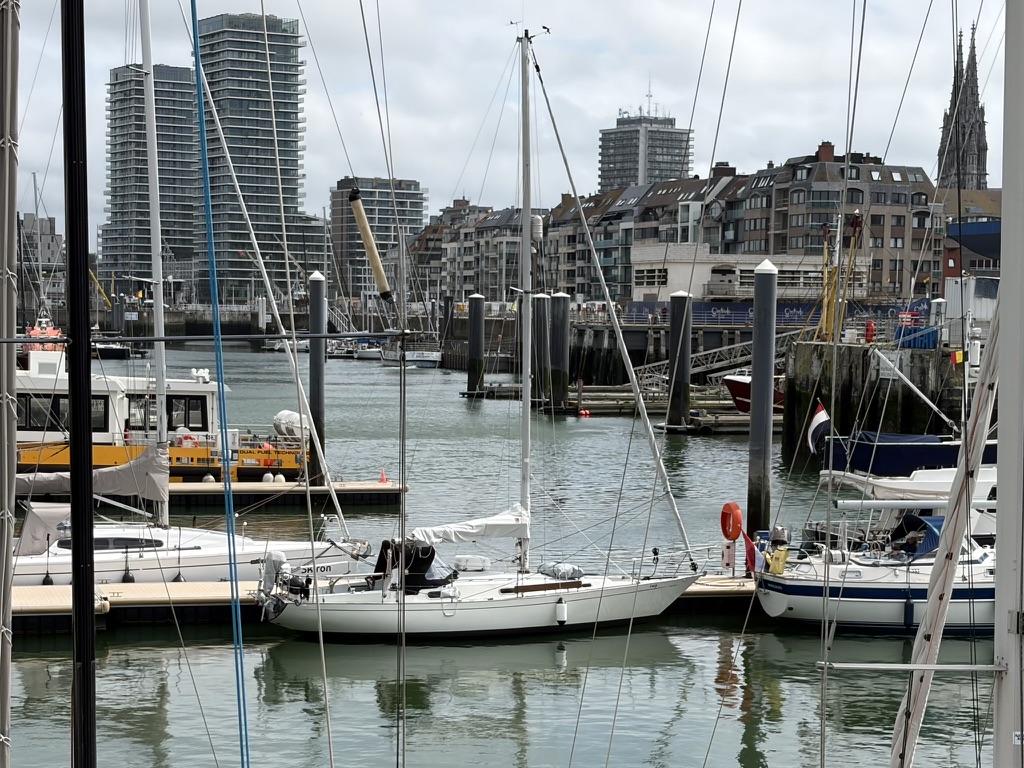
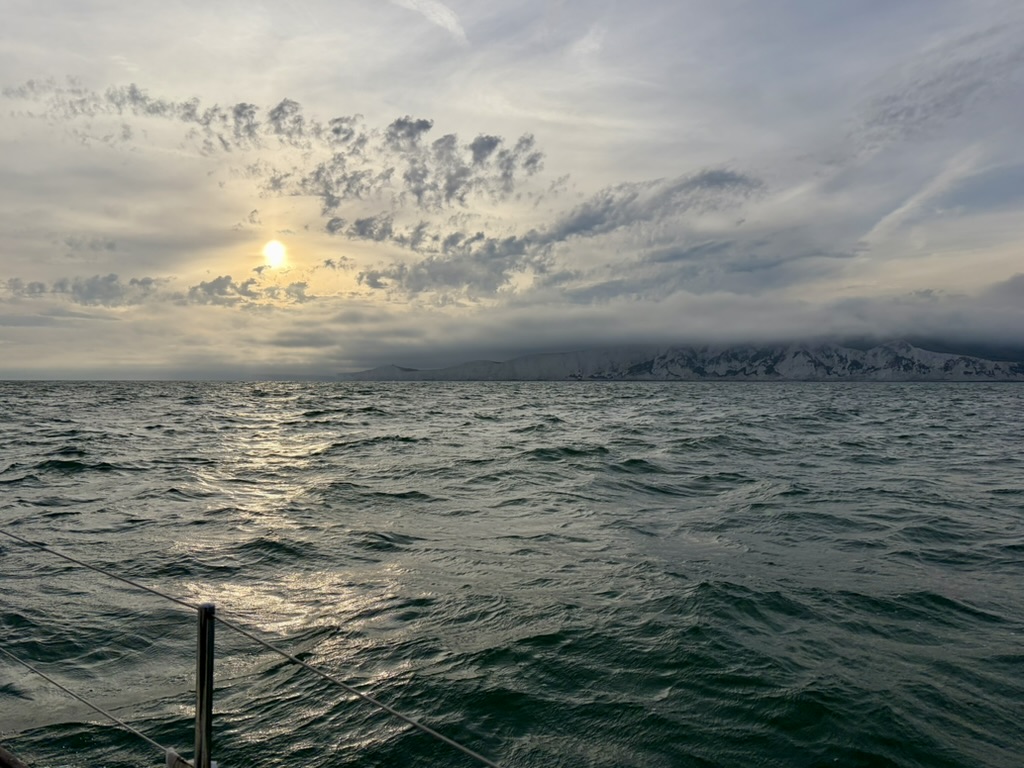
So much for “Gentlemen don’t sail to windward”. All our waiting for sailable winds had been in vain – the south-westerly remained faithful to us. The passage took longer than planned, and we finally reached Lymington on 17 June. There is no denying that the voyage was hard work at times, yet, looking back, the good memories decidedly outweigh the difficult ones. There were the challenges of tidal navigation, and the satisfaction when, after a full day’s sailing, the stream placed Lucy off the mighty harbour of Dover exactly as calculated. There was our departure from Brighton at 2 am in fog with visibility of less than 50 m, and the beat in a strong wind through the Solent to the entrance of Lymington harbour 12 hours later. There, from a dinghy, comes a cheerful “Welcome to Lymington!” What a lovely surprise to be welcomed by Kit Rogers himself! Kit took over the Jeremy Rogers ‘Contessa’ yard from his father and ran it for many years.
There were long passages and plenty of effort, but also those companionable morning chats over coffee with Karsten in the saloon on days when the weather kept us from making headway. Yes — it all came together beautifully!
Peter Skyba
Photos#